
Navigating eCommerce finances overcoming hurdles with automation
Explore the common accounting challenges faced by ecommerce businesses and discover how automation serves as a transformative solution
TL;DR: The biggest eCommerce accounting challenges are recording net deposits as gross revenue, mishandling platform fees, incorrect sales tax treatment, and reconciling settlements across multiple channels. Automation tools like SyncTools solve each by pulling transaction-level data from your platforms and posting every sale, fee, refund, and tax line to the correct account — automatically.
The global surge in eCommerce has brought one of the most rapidly expanding industries — and one of its most demanding accounting environments. Managing inventory, fulfillment, payment processing, and multi-channel settlement reconciliation at scale creates accounting complexity that standard bookkeeping tools weren’t designed to handle.
Efficient accounting is the backbone of any successful eCommerce venture, and the hurdles are distinctive and demanding. This guide covers the most common accounting obstacles online retailers face and explains how automation resolves each one.
Common accounting challenges in eCommerce
Over the last decade, the eCommerce sector has experienced substantial expansion.
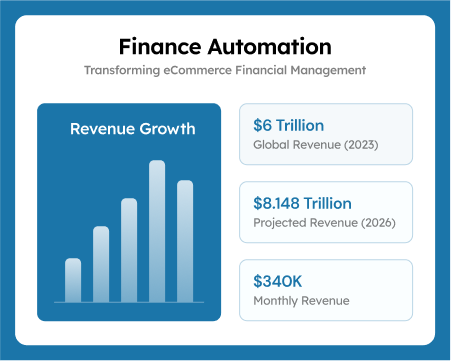
International revenue surpassed $6 trillion in 2023.
Projections indicate a further increase to $6.9 trillion in 2024 and a subsequent rise to $8.148 trillion by the conclusion of 2026, according to Statista.
However, dealing with the complex world of online business comes with many challenges for companies.
Here are some of the common finance hurdles that e-commerce faces.
High transaction volumes
eCommerce businesses deal with a myriad of daily transactions, creating a breeding ground for potential errors and discrepancies. Sellers on multiple channels face additional complexity — see the multi-channel inventory accounting guide.
The sheer volume of financial data requires meticulous attention, making manual processing a time-consuming and error-prone endeavor.
Complex inventory management
Managing multiple SKUs, variations, and real-time tracking presents a labyrinth of challenges.
eCommerce retailers must grapple with the intricacies of inventory, striving to prevent stockouts while avoiding overstock situations that can lead to financial losses.
Varied payment methods
Cashless payment transactions are poised to surge by 200% before the year 2030, ultimately phasing out traditional cash-based systems entirely, according to an article published in IOL.
But with a plethora of payment options available to consumers today, reconciling payments becomes a convoluted process.
E-commerce companies need to navigate through various payment gateways, each with its own set of reconciliation complexities.
Tax compliance issues
The complex and ever-changing landscape of tax regulations poses a significant challenge for eCommerce businesses.
Accurately calculating and reporting taxes is a daunting task that demands constant vigilance to avoid legal repercussions.
Time-Consuming manual tasks
The reliance on manual data entry and reconciliation not only consumes valuable time but also leaves room for errors.
eCommerce businesses often find themselves allocating resources to mundane tasks that could be better utilized in strategic financial planning.
How automation addresses eCommerce accounting challenges
In a fast-paced eCommerce landscape, understanding fields like automation and data science can be a significant advantage.
As one of the most lucrative majors, automation technology equips professionals with skills to:
- **Automate repetitive tasks**
- **Streamline workflows**
- Free up time for **strategic initiatives** that drive growth
Graduates from the most lucrative majors, such as automation and business analytics, are in high demand, as they bring specialized knowledge to optimize operational efficiency and improve decision-making in competitive markets.
This expertise is crucial for businesses aiming to scale and maintain a competitive edge.
The integration of Shopify to QuickBooks, for example, could help overcome these challenges and streamline the accounting workflow. For a complete setup walkthrough, see our Shopify QuickBooks integration guide.
By leveraging automation, eCommerce businesses can:
- Reduce errors
- Improve efficiency
- Enhance the customer experience
Streamlining transaction processing
One of the primary challenges in e-commerce accounting is the handling of high transaction volumes.
With a multitude of daily transactions, the risk of errors and discrepancies looms large. Automation tools bring a breath of fresh air by automating data entry and categorization.
This not only expedites transaction processing but also minimizes the likelihood of human errors, ensuring accuracy and reliability in financial records.
Efficient inventory management
eCommerce businesses also grapple with the intricate puzzle of inventory management.
Multiple product variations, stockouts, and overstock scenarios create a web of challenges.
Automation solutions provide a lifeline, offering real-time tracking and efficient management of diverse SKUs.
This not only prevents financial losses due to inventory mismanagement but also empowers businesses with data-driven insights for strategic decision-making.
Integrated payment solutions
The diverse landscape of payment methods in ecommerce adds another layer of complexity.
Reconciling payments from various gateways can be time-consuming and error-prone.
Automation tools integrate seamlessly with multiple payment options, streamlining the reconciliation process.
This not only ensures accuracy but also enhances the overall customer experience by providing a smooth and hassle-free payment process.
Automated tax compliance tools
Tax compliance, with its ever-changing regulations, is a constant source of anxiety for eCommerce businesses.
Automated tax compliance tools act as vigilant guardians, keeping businesses abreast of the latest changes and facilitating accurate calculations and reporting.
This not only mitigates the risk of non-compliance but also instills confidence in stakeholders.
Time and resource savings
Automation eliminates the need for extensive manual data entry, freeing up valuable resources.
eCommerce businesses can redirect these resources towards strategic financial tasks, fostering growth and sustainability.
Tips to implement process automation in your eCommerce business
Implementing accounting automation not only saves time but also reduces the risk of human error, ensuring accurate financial data.
Here are guidelines to seamlessly integrate accounting automation into your eCommerce business:
Evaluate current processes
Begin by conducting a comprehensive assessment of your existing accounting procedures.
Identify repetitive tasks, manual data entry, and areas prone to errors.
This will serve as a baseline for understanding where automation can bring the most significant benefits.
Choose the right software
Selecting the appropriate accounting software is crucial.
Look for solutions that cater specifically to ecommerce needs, offering features like inventory tracking, order management, and integration capabilities with your existing systems. For a comparison of accounting software options, see the best eCommerce accounting software guide.
Integrate eCommerce platforms
Streamline your operations by integrating your ecommerce platform directly with your chosen accounting software.
This integration ensures seamless data flow between sales, inventory, and financial records, reducing the need for manual data entry.
Implement cloud-based solutions
Embrace cloud-based accounting solutions for accessibility and flexibility.
Cloud platforms allow you to access financial data from anywhere, facilitating collaboration among team members and providing real-time insights into your business’s financial health.
Automate invoice generation and payments
Automate the creation and distribution of invoices as well as payment reminders.
This not only saves time but also accelerates cash flow by reducing delays in the billing cycle.
Utilize machine learning for data analysis
Leverage machine learning algorithms to analyze financial data and identify patterns, trends, or anomalies.
This proactive approach can help in making informed business decisions and spotting potential issues before they escalate.
Train your team
Ensure your team is well-versed in using the new automated system.
Provide training sessions to familiarize them with the software and encourage ongoing education to keep up with updates and new features.
Overcome eCommerce finance challenges with business automation and tools
Process automation is a powerful tool and Multi-channel eCommerce accounting software SyncTools, that can help eCommerce businesses overcome the many challenges they face.
By leveraging automation technology, businesses can:
- Reduce errors
- Improve efficiency
- Enhance the customer experience
Additionally, finance process automation can help businesses to scale more effectively and adapt to changing market conditions.
As eCommerce continues to grow and evolve, the importance of process automation will only become more apparent, making it a critical investment for any business seeking to succeed in this fast-paced industry.
Frequently Asked Questions
What are the biggest accounting challenges for eCommerce businesses?
The most common accounting challenges for eCommerce businesses are recording net deposits as gross revenue, mishandling platform fees, incorrect sales tax treatment, and reconciling multi-channel settlements. Automation tools like SyncTools solve these by mapping each transaction type to the correct account automatically.
How does automation help with eCommerce accounting?
Accounting automation pulls transaction-level data from platforms like Shopify and Amazon, maps each transaction type (sales, fees, refunds, taxes) to the correct chart of accounts, and keeps records current without manual data entry or CSV exports.
Can SyncTools connect Shopify to QuickBooks automatically?
Yes. SyncTools connects Shopify to QuickBooks Online and syncs sales, fees, refunds, and tax data automatically on a schedule you define — eliminating manual exports and reconciliation.
What is the most common eCommerce accounting mistake?
The most common mistake is recording the net deposit from Shopify, Amazon, or another platform as gross revenue. Net deposits are already reduced by platform fees, refunds, and chargebacks. Recording net deposits as revenue understates fees and overstates margins. The correct approach is to record gross sales and each deduction separately — which SyncTools handles automatically by mapping each transaction component to the correct QuickBooks or Xero account.
How much time does eCommerce accounting automation save?
According to Intuit’s 2024 Business Solutions Survey, businesses spend an average of 25 hours per week on manual data entry and cross-app reconciliation. For eCommerce sellers with multiple sales channels, automation tools like SyncTools typically reduce monthly reconciliation time from several hours to under 30 minutes by eliminating manual CSV exports, fee categorization, and payout matching.
For more on tackling eCommerce finance complexity, see the multi-channel eCommerce accounting guide, the eCommerce bookkeeping guide, the AI-powered automated reconciliation software guide, and the automated reconciliation for eCommerce guide. For a beginner-friendly overview of how SyncTools works, see the SyncTools eCommerce accounting guide.
One of the most complex challenges — and one where automation has the biggest impact — is multi-state sales tax compliance. For a complete breakdown of economic nexus thresholds, marketplace facilitator rules, and how to reconcile platform-collected tax in your accounting system, see the ecommerce sales tax compliance guide.
For platform-specific accounting breakdowns — including how TikTok Shop referral fees and affiliate commissions are handled, or how Walmart WFS fees differ from Amazon FBA in your books — see the TikTok Shop accounting guide and the Walmart Marketplace accounting guide.
Ready to automate your accounting?
Connect Shopify, WooCommerce, or Linnworks to QuickBooks, Xero & more. Setup in minutes.

